

Article: What are lab grown diamonds: the truth about quality
What are lab grown diamonds: the truth about quality
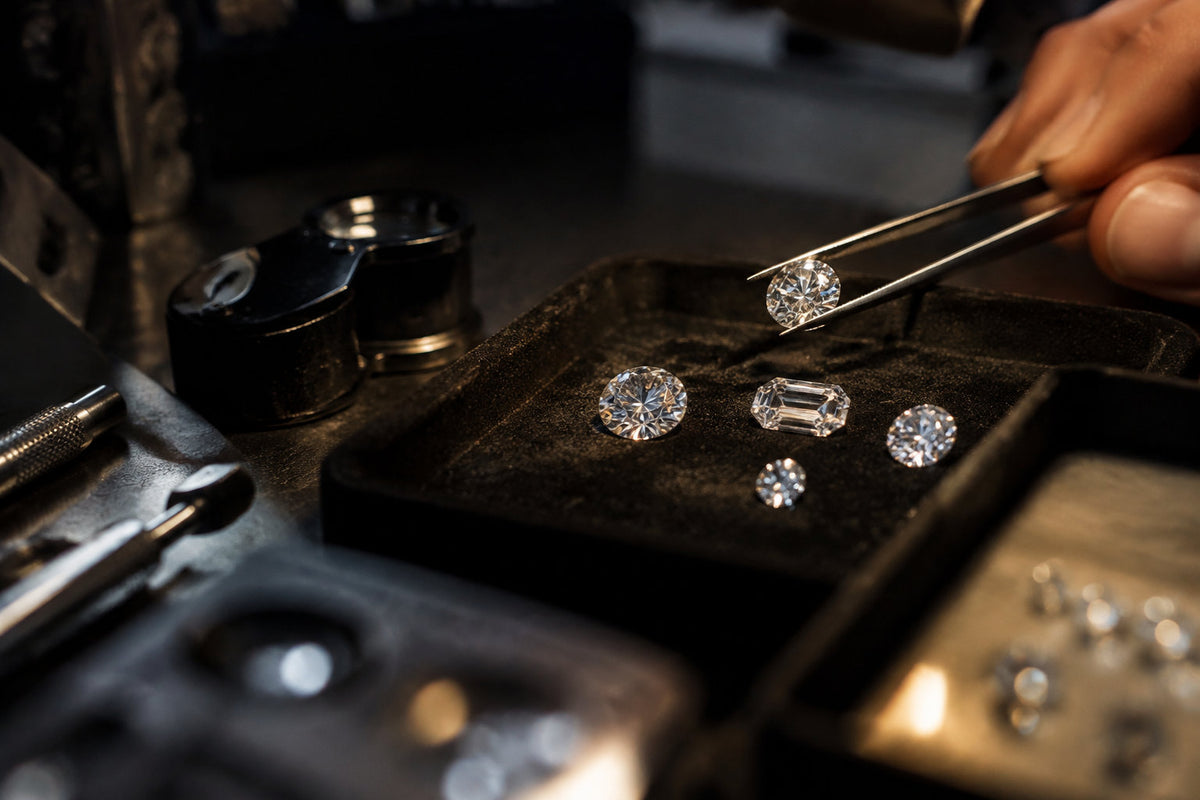
Lab-grown diamonds are real diamonds made in a laboratory, and they look the same as mined stones.
Since the eye cannot tell them apart, the buyer needs another way to judge quality. This article explains what these stones are, how they are made, and whether their quality matches mined diamonds.
What are lab-grown diamonds: real diamonds grown in a laboratory
A lab-grown diamond is a real diamond, made in a laboratory instead of underground. It has the same chemical composition and crystal structure as a mined stone.
Cubic zirconia and moissanite are different materials, so neither one is a diamond. Cubic zirconia is zirconium oxide, and moissanite is silicon carbide.
Lab-grown and mined diamonds look the same to the naked eye, and hardness and refractive index do not separate them either. Only a laboratory test shows the origin, so ask for a grading report that names the stone as lab-grown. To see how such a stone is set, look at 14-karat pear-shape lab-grown diamond studs.
How HPHT and CVD methods form lab-grown diamonds
HPHT: high pressure, high temperature
Lab-grown diamonds are made by two main methods.
In HPHT (high pressure, high temperature), a small diamond seed and carbon sit in a chamber with a metal catalyst, at about 1,300 to 1,600 °C and 5 to 6 GPa of pressure. Growth takes a few days to a few weeks, depending on the intended size of the stone.
CVD, for chemical vapour deposition, takes a different route. A carbon-containing gas enters a vacuum chamber at about 700 to 1,300 °C, at lower pressure than HPHT.
Carbon settles on a seed and builds the crystal, usually over four to six weeks.
Many CVD stones then get HPHT treatment after growth, often to remove brown colour, and a grading report can show which method grew the stone. For a ring setting, see the 14-karat eternity U-setting lab-grown diamond ring.
CVD: chemical vapour deposition
CVD works like this:
- Carbon-containing gas enters a vacuum chamber at about 700 to 1,300 °C.
- Carbon crystallises on a seed over four to six weeks.
- Many stones receive HPHT treatment to alter colour, and a report can show the method.
Quality depends on cut, colour and clarity, not on origin
A lab-grown stone can be well or poorly cut, just as a mined one can. Cut drives brightness, fire and sparkle, so judge it with the 4Cs. For an oval shape, see this lab-grown oval ring as an example.
GIA’s service for colourless to near-colourless lab-grown stones of at least 0.15 carats gives a Premium or Standard assessment, not natural-diamond grades. Premium needs D colour, VVS clarity or better, and Excellent polish and symmetry.
Standard allows E to J colour and VS clarity or better, with Very Good polish and symmetry.
Round brilliants also need an Excellent cut for Premium, Very Good for Standard. A report confirms identity and assessed quality, not future resale value.
Telling lab-grown from natural needs laboratory testing
A lab-grown diamond cannot be identified by eye. Even a trained jeweller or gemologist cannot tell it from a mined stone by sight alone.
Laboratories use specialist equipment instead. They examine inclusions and growth patterns, check fluorescence under ultraviolet light, and use spectroscopy, which can also show whether a stone grew by HPHT or CVD.
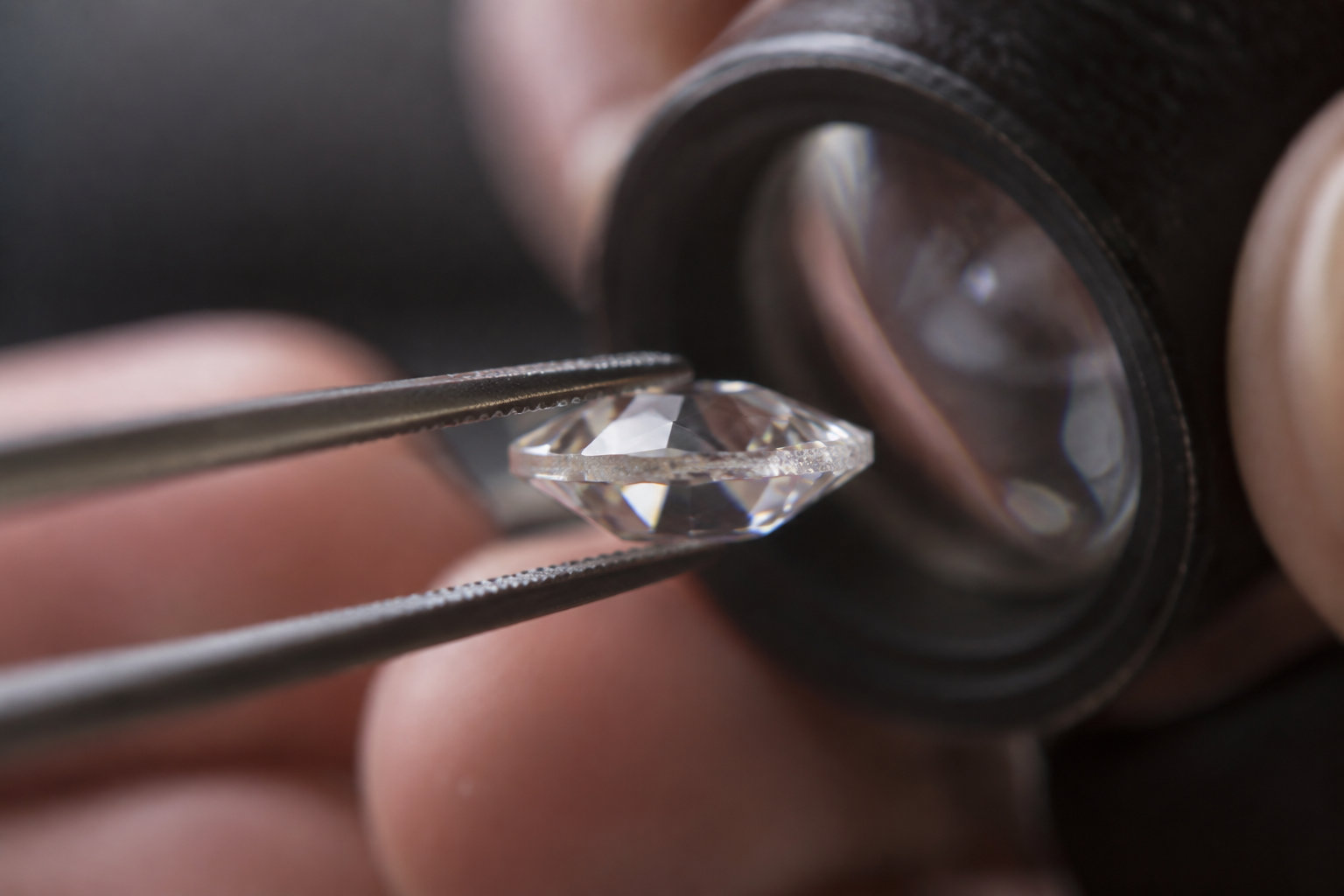
When buying, check that the grading report names the stone as laboratory-grown and that its details match the stone, including the laser inscription on the girdle. For a 14-karat gold ring with lab-grown stones, see the semi eternity milgrain ring.
Lab-grown stones usually cost far less than mined diamonds
Lab-grown stones usually cost far less than mined ones. In an October 2026 sample of online listings from four retailers, they averaged 88% less than natural diamonds matched by shape, carat, colour and clarity.
Treat that 88% as a snapshot, not a guarantee. For a one-carat round with G colour and VS1 clarity, the US median listing was $350 for lab-grown and $3,419 for natural.
Listings with identical specifications still differ widely, so compare several before you buy. Those figures are US prices, not prices in Canada or France. For a finished piece in 14-karat gold, see the lab-grown solitaire pendant.
Resale value of lab-grown diamonds is low and uncertain
Treat a lab-grown stone as jewellery, not as an investment. Some jewellers do not buy back lab-grown diamonds at all, and others offer store credit instead of cash.
One resale estimate puts lab-grown stones at 10 to 30 percent of their original retail price. It is an estimate, not a guaranteed offer. Actual offers depend on the stone, its grading report, the buyer and current prices.
No established second-hand market exists yet. Before buying, ask for buyback or trade-in terms in writing, since a trade-in credit is not cash resale. If you want a piece to wear, see the five-stone lab grown diamond ring.
Environmental claims depend on how the stone is grown
Lab-grown diamonds avoid mining the stone itself, but that alone does not make them low-impact. Growing one uses a lot of electricity, and emissions depend mostly on the energy source and plant location.
A study published in Nature puts mined diamonds at 57 kg of greenhouse-gas emissions per carat. Lab-grown stones made with clean energy come to 0.028 g per carat. The gap holds only under that study’s assumptions and energy conditions.
Industry estimates differ sharply, so ask for independent third-party proof of any lower-impact claim. For a bridal set, see bridal crown ring in 10-karat gold. For stones set along a bracelet, see semi-eternity bangle in 14-karat gold.
A lab-grown diamond is a real diamond with the same structure as a mined one. Cut, colour and clarity set its quality, and it is best bought as jewellery, not as an investment.
Before you buy, ask for a grading report that names the stone as lab-grown, and check that it matches the stone. Get buyback terms in writing.
Frequently Asked Questions
Is VS1 or VS2 clarity better for a lab-grown diamond?
VS1 is the higher grade, but VS2 is usually the smarter pick for a lab-grown diamond, because both grades have only small inclusions and the cut has a bigger effect on sparkle.
Put your budget into the cut first, then choose the clarity grade that fits what is left.
Do lab-grown diamonds get cloudy over time?
No, a lab-grown diamond does not go cloudy on its own. It looks dull when oil or dirt covers its surface, and a mined diamond does the same.
Clean it with the care instructions for its setting, and it sparkles again.
Why do some jewellers dislike lab-grown diamonds?
Jewellers hold different views on lab-grown diamonds, because the stones change the trade.
They cost far less than mined stones, so a shop selling mined diamonds earns less on each sale. Before you buy, ask your jeweller about servicing, trade-ins and buybacks.
Are lab-grown diamonds suitable for engagement rings?
Yes. A lab-grown diamond has essentially the same chemical composition and crystal structure as a natural diamond, so it can be set in an engagement ring just like a mined stone.
Choose the cut, setting and care that suit how you plan to wear the ring.


Laisser un commentaire
Ce site est protégé par hCaptcha, et la Politique de confidentialité et les Conditions de service de hCaptcha s’appliquent.