

Article: Oval engagement rings: the meaning behind the shape
Oval engagement rings: the meaning behind the shape
No traditional meaning is fixed for the oval engagement ring, though many buyers assume one exists.
So the real question is what the ring should stand for to you, and whether the shape suits your hand.
This article separates the documented facts about oval style, proportions and setting from unsupported symbolic claims, and shows you how to choose and set one.
Oval engagement rings meaning: what the shape says and what it does not
No single traditional meaning is established for the oval shape. Its rounded edges and elongated outline are style impressions. Graceful and modern are ways to describe the look, not a fixed message for every couple.
Its cut is measurable: usually a brilliant with 57 or 58 facets, as on a standard round, so it sparkles much like one. Judge the stone by its measurements, not by a meaning.
Pick an oval because you like how it looks, then agree together on what the ring stands for. The shape alone will not tell anyone your story. To see a 10-karat oval setting before you decide, look at the oval created gemstone and diamond ring.
Why couples choose an oval: finger length and apparent size
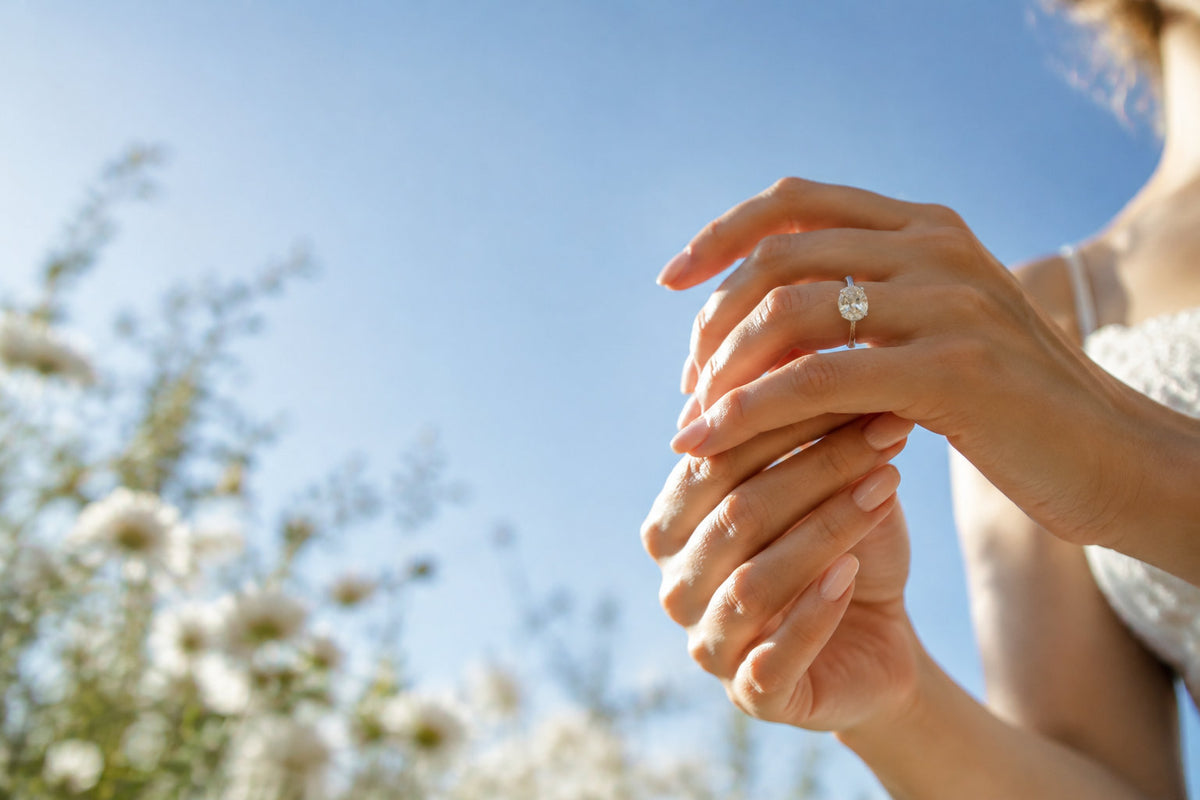
The oval’s elongated outline can make fingers look longer and slimmer. A jeweller quoted by Vogue describes the shape as "a softer, more directional silhouette that elongates the hand in a really flattering way."
The stone draws the eye along the finger, so the hand looks slimmer. That effect depends on the stone’s proportions, so check its length-to-width ratio before you buy.
Carat measures weight, not face-up size, so a 1-carat oval can look larger than a 1-carat round. A typical 1-carat oval measures about 7.7 × 5.7 mm, while a typical 1-carat round measures about 6.5 mm across. Before you buy, compare the millimetre measurements of each stone.
For a dainty oval in 10-karat gold, look at the dainty oval created gemstone and diamond ring.
Oval or round: how the two shapes differ in outline, sparkle and price
A round diamond has a circular outline, so its width is the same in every direction. An oval has a longer outline, so it can cover more of the top of the finger.
Both shapes can have brilliant facets, the small angled faces that return light to the eye. An oval looks similar to a round brilliant, but its sparkle is not identical, because its shape and facets differ.
Ovals usually cost less than rounds of the same carat weight, but these ranges are not a like-for-like quote. For a 14-karat gold setting with 0.49 carats of diamonds, see the Bridal Diamond Engagement Ring.
| Criterion | Round brilliant | Oval |
|---|---|---|
| Price, 1 carat (indicative) | US$6,000–7,000 | US$4,800–5,800 |
| GIA overall cut grade | Yes | No, only polish and symmetry |
| Cut check | Standardized facets, graded | Check symmetry, outline and sparkle by eye |
How to choose an oval diamond: ratio, colour, clarity and the bow-tie
The length-to-width ratio is the stone’s length divided by its width. A ratio of 1.30 to 1.40 looks rounder and more evenly balanced. A ratio of 1.41 to 1.50 looks longer and more dramatic.
Guidelines differ. Some treat 1.40 to 1.50 as the traditional oval look, so a stone in that range can look classic to one buyer and too long to another.
Beyond the ratio, check these three points:
- Colour: ovals show colour more clearly than rounds, so compare stones in person first.
- Clarity: check the grade on the certificate, then look at the stone under good light.
- Bow-tie: judge it by turning the stone in light, since a still image may not show how it changes.
- For a halo setting around the stone, see double halo diamond engagement ring.
Which settings bring out the outline of an oval stone
A solitaire keeps the oval as the main focus. With one stone and no side stones, the eye goes straight to the outline. One jeweller calls this minimal style fresh and modern.
The stone can be set vertically, with its length running along the finger, or sideways, with its length running across it. Sideways is called east-west, and it makes the stone read wider across the finger.
Each setting changes how the oval’s outline reads:
- Side stones add detail beside the centre diamond. The three-stone look belongs to setting tradition, not to the oval itself.
- A halo places smaller stones around the diamond. For that frame, see this oval halo ring.
- In an east-west setting, the long axis runs across the finger instead of along it.
- A bezel places metal around the diamond’s edge. Choose the setting that suits your look and holds the stone securely.
Oval rings through history, from 18th-century outlines to the 1957 brilliant
Oval-like outlines are older than the modern oval. Diamond cutters experimented with them as early as the 18th century, while they were learning to shape rough crystals in different ways.
The oval most jewellers sell today came later. Diamond cutter Lazare Kaplan is credited with developing the modern oval brilliant in 1957. Its 58 facets give an elongated outline the sparkle of a round brilliant.
The oval is a story of cutting and outline more than of symbolism. Cutters tried many outlines long before the modern oval, and its elongated shape is what sets it apart from a round.
The brilliant facets keep the round’s style, so the oval sparkles in a similar way. If you want a different outline, look at cushion halo engagement rings and compare the shapes side by side.
Oval Invisible with Accent Diamond Ring: a 10K gold option
The Oval Invisible with Accent Diamond Ring by RNB Jewellery is set in 10K gold. It holds 31 natural accent diamonds, totaling 0.25 ct, and is priced at 999.0 CAD.
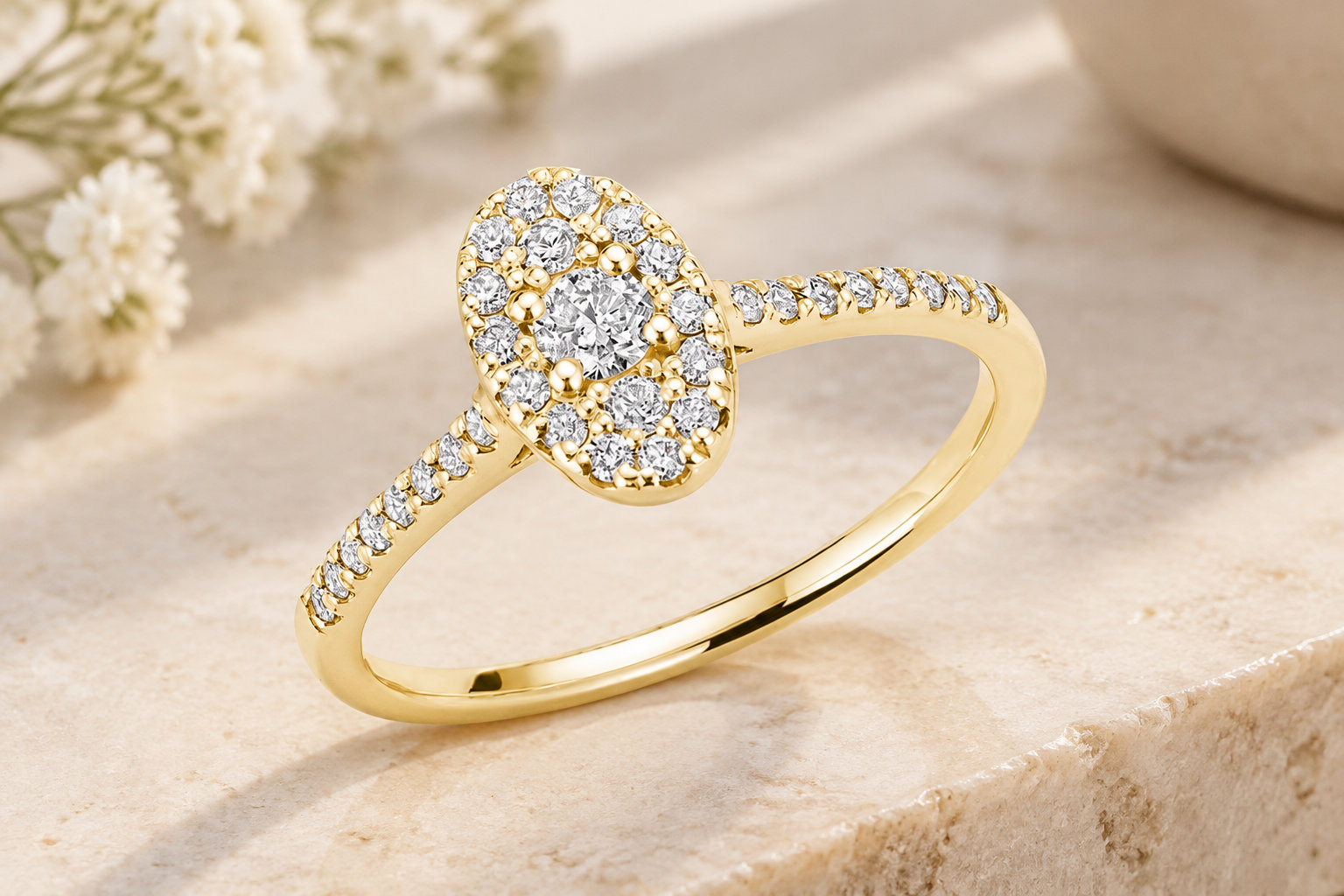
The accent stones are small, so the oval stays the center of attention. 10K is a lower gold purity than 14K or 18K, so compare its price with other gold options in your budget.

Before you buy, check these points:
- Colour: yellow gold or white gold.
- Size: from 4 to 12, including quarter and half sizes.
- Resizing: ask RNB Jewellery first. A fee applies, and you pay the shipping to send the ring in.
- Halo style: for a halo around the oval, see the pointed halo ring.
- Double halo: for two rings of stones around the centre, see the double halo ring.
The oval has no fixed meaning, so the shape says nothing by itself. Its outline, length-to-width ratio and millimetre size are what you can measure. Agree with your partner on what the ring stands for.
Before you order, ask for each stone’s millimetre measurements and certificate, and look at the ring in person under good light.
Frequently asked questions
What does the oval shape symbolize?
The oval shape has no fixed meaning. No traditional message is attached to every oval ring, so choose it for how it looks, and decide with your partner what the ring stands for.
What is more expensive, a round or an oval diamond?
A round brilliant typically costs more than an oval of the same carat weight. Each stone’s price depends on its qualities, such as colour, clarity and cut, so compare stones of similar quality before you decide.
Does an oval diamond look bigger than a round one of the same carat weight?
Yes, it can. An oval’s longer face-up shape covers more of the finger than a round of the same carat weight, so it can look bigger when worn.
Whether it does depends on the stone’s own measurements, so compare them before you buy.
What is the bow-tie effect in an oval diamond?
The bow-tie effect is a dark, bow-shaped area that runs across the centre of an oval diamond. It can be faint, or so dark that it distracts from the sparkle.


Leave a comment
This site is protected by hCaptcha and the hCaptcha Privacy Policy and Terms of Service apply.